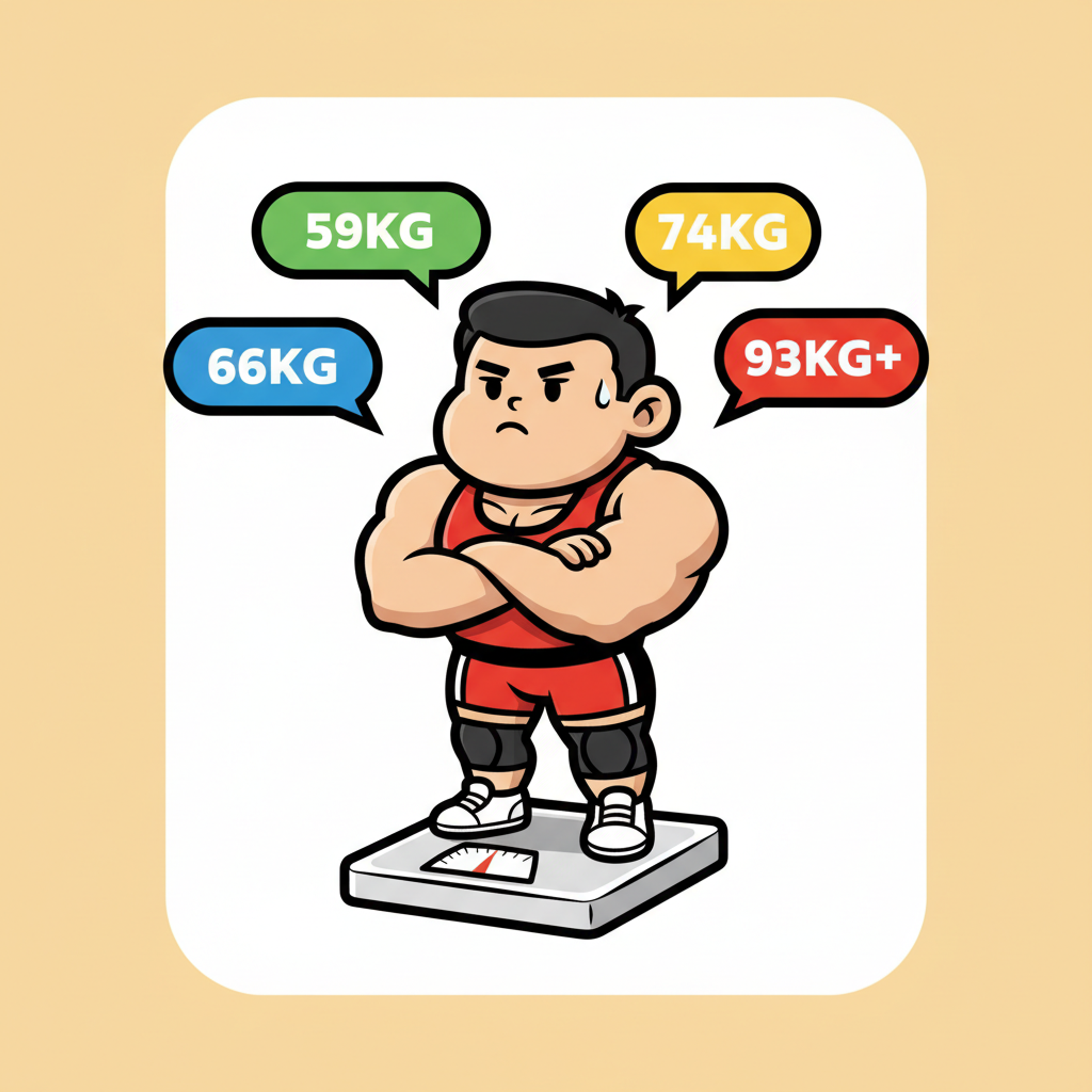
Most first-time powerlifters pick a weight class the same way they pick a shirt size: by their current bodyweight. That is the wrong framework.
Your weight class should be determined by where your strength-to-bodyweight ratio peaks, not where you happen to land on the scale today.
The Basic Math
Every weight class has a ceiling. The question is not "am I under the limit?" but "how much am I leaving on the platform by being in this class?"
There are two failure modes:
- Too light for your class. You are competing against people who are bigger and stronger. You are a large fish in a large pond.
- Too heavy for your class. You are cutting water weight to make weight, showing up depleted, and lifting below your capability.
The optimal class is where you are near the top of the limit without a miserable cut.
Walking Weight vs. Competition Weight
Your walking weight is what you weigh on a normal day. Your competition weight is what you weigh on the scale at weigh-in.
The difference between these two numbers is your cut. There are three types:
Cut type | Range | What it involves
Water manipulation | 1–3% of bodyweight | Reduced water intake, sauna, sweat suit
Moderate cut | 3–6% | Multi-day water and sodium depletion
Large cut | 6%+ | Everything above plus extreme dehydration
Rule of thumb: a cut over 5% will cost you more than it saves. The performance penalty of severe dehydration — reduced strength, slower neural transmission, joint fluid depletion — exceeds any competitive advantage you get from the lower class.
How to Find Your Optimal Class
- Weigh yourself under normal conditions (morning, post-toilet, before eating).
- Find the closest class below your walking weight.
- Calculate the cut. If it's under 5%, that class is viable. If it's over 5%, move up.
- Consider your trajectory. Are you still building muscle? A class that fits now may be wrong in 12 months.
Example
An 85kg lifter at 84kg walking weight:
- 83kg class requires a 1kg cut — trivial water manipulation. Viable.
- 74kg class requires a 10kg cut — dangerous, performance-destroying. Wrong class entirely.
The Strength-to-Bodyweight Angle
Some lifters choose a class based on where their wilks/IPF GL points are competitive, not just where they fit. This requires looking at national or local results and being honest about where you stack up.
If you are a 93kg lifter with a 600kg total, you are not competitive at 93kg nationally. You might be competitive at 83kg with a moderate cut — or you accept the longer timeline of building to where 93kg is your natural home.
The Underrated Option: Move Up
Going up a class is not failure. It is often the smarter play for a lifter who is still gaining muscle. Competing at a class you are already near the top of, without a cut, means:
- No performance penalty from dehydration
- Better recovery into competition day
- More room to train heavier in the off-season without constant weight management
The best total wins the meet, not the lowest number on the scale.
About Rasmus
Powerlifter and coach with more than 7 years in the game.