You trained legs yesterday. Can you train them again today?
The standard bro-split answer is "no, wait a week." The real answer is: it depends on what system you're taxing.
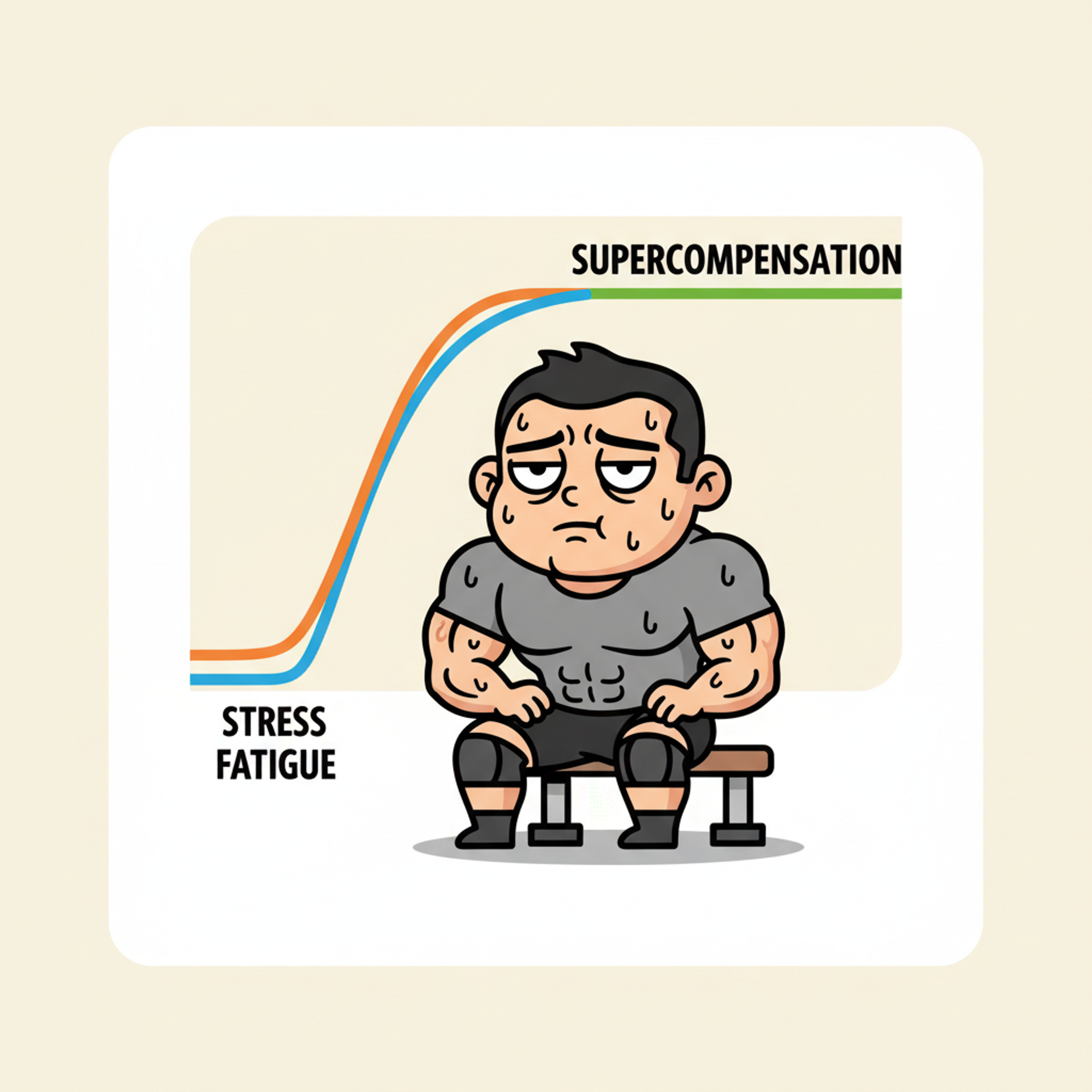
The body is not a single unit. It is a collection of systems—nervous, muscular, connective—that recover at drastically different rates. This is the SRA Curve (Stimulus-Recovery-Adaptation). It describes the cycle after a training stress:
- Stimulus: Performance drops immediately (fatigue).
- Recovery: Performance returns to baseline.
- Adaptation: Performance exceeds baseline (supercompensation).
Understanding these timelines lets you train more frequently without burning out—or rest enough to actually grow.
The Three Critical Timelines
1. The Nervous System (Skill / Motor Learning)
- Recovery Time: ~24 hours.
- Mechanism: Synaptic facilitation. "Greasing the groove" strengthens the signal.
- Implication: You can practice technique almost daily.
A light squat session at 50–60% doesn't cause structural muscle damage and doesn't drain your systemic energy. It reinforces the neural pathway. This is why Olympic weightlifters squat every day—they treat the lift as a skill, not just a workout.
2. The Muscular System (Hypertrophy / Energy Substrates)
- Recovery Time: 48–72 hours.
- Mechanism: Protein synthesis and glycogen replenishment. Micro-tears need to be fused and the muscle refueled.
- Implication: A muscle group is usually ready again after 2–3 days.
* Waiting a full week between leg days is inefficient. By day 4, the muscle has recovered and is effectively detraining for 3 days.
* High-frequency training (2–4x per week per muscle) exploits this curve to stimulate growth more often.
3. Connective Tissue & Axial Loading (The Limiter)
- Recovery Time: Days to weeks.
- Mechanism: Tendons and ligaments have poor blood supply—roughly 1/10th of muscle. They heal slowly. The spine also takes a long time to rehydrate and recover from compressive loading.
- Implication: While your quads might be ready to squat in 48 hours, your lumbar spine might need 4–5 days after a heavy deadlift session. This is the limiting factor in heavy training.
SRA Mismatches: The Danger Zone
The danger lies in the mismatch between these curves.
Scenario: It's Thursday. You deadlifted heavy on Monday.
- Muscles: Hamstrings feel fine. Muscle SRA complete.
- Nerves: Mentally ready. Neural SRA complete.
- Joints: Lower back still subtly stiff. Hips feel "dry." Connective SRA incomplete.
You decide to max out on squats because you "feel good." You snap something.
If you ignore the slowest curve (connective tissue), you get injured. If you ignore the fastest curve (neural), you stay weak.
Programming the Curves
You rotate stressors to fit these different timelines into a weekly schedule.
The Heavy-Light-Medium System:
- Monday (Heavy): Heavy squat + heavy bench. Taxes all three systems maximally. SRA clock starts.
- Tuesday (Accessory): Back, biceps, abs. Low axial load. Lets the spine recover while hitting different muscles.
- Wednesday (Light – Neural Focus): Paused squats at 70%. Light enough not to reset the spine's recovery clock, but enough to reinforce the squat pattern.
- Friday (Medium – Hypertrophy): Deadlifts + high-rep pressing. Spine has had 3–4 days since Monday. Muscles are fresh.
Because the deadlift imposes the highest axial fatigue of any lift, heavy deadlifts are rarely done more than once a week. Even if your hamstrings could handle more, your spine probably can't.
Respect the slowest timeline.
About Rasmus
Powerlifter and coach with more than 7 years in the game.