If you are currently debating the optimal angle of your pinky finger during a tricep extension but haven’t tracked your total training volume in six months, you are the problem.
The fitness industry thrives on selling "secrets"—magic bullets that promise to bypass the hard work. In reality, strength training is governed by a rigid hierarchy of physiological laws. Ignoring the foundation to focus on the peak is not "optimization." It is negligence.
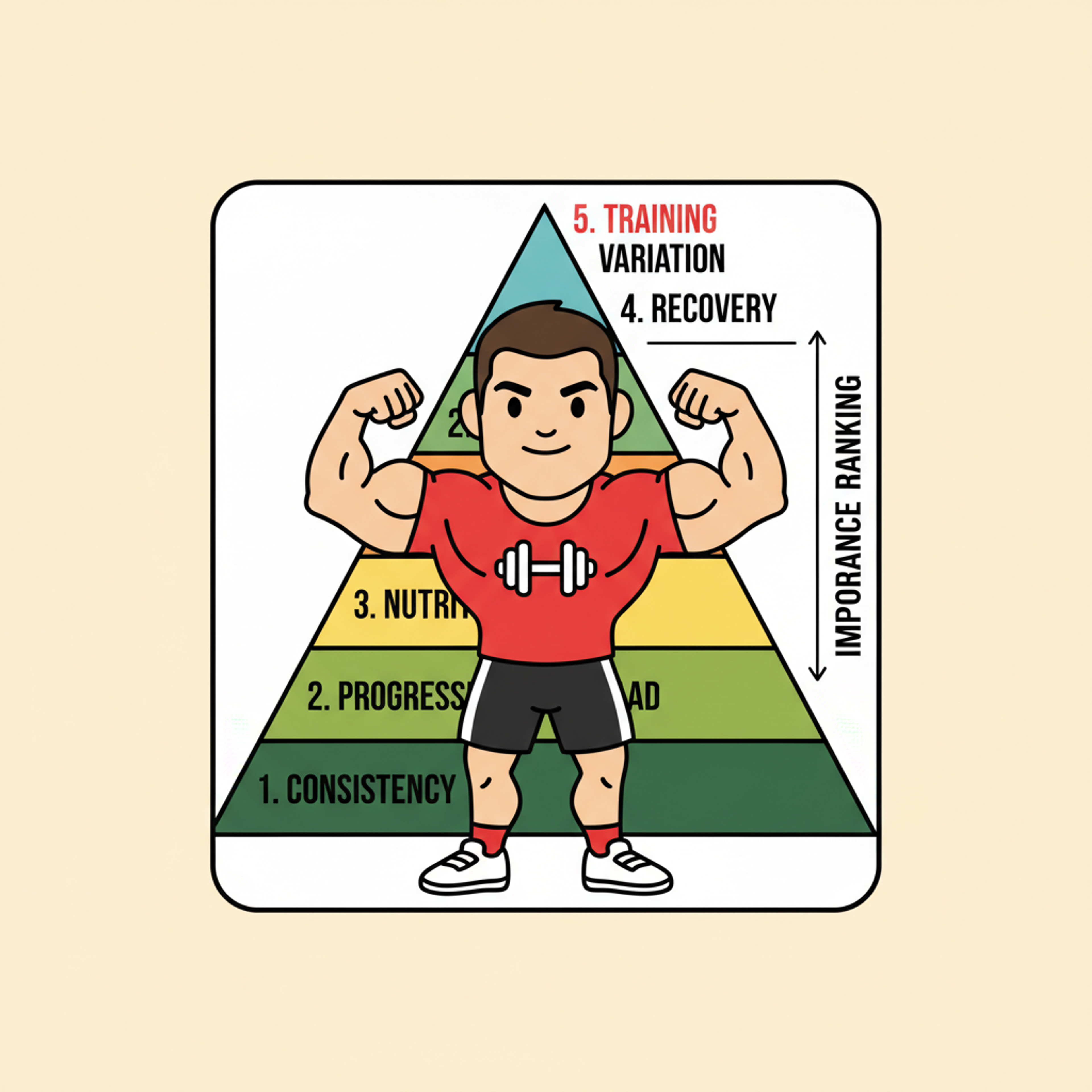
The Pyramid of Importance
Eric Helms popularized the concept of the training pyramid. It ranks variables by their magnitude of effect. If you violate a lower level, nothing above it matters.
1. Specificity (The Foundation)
This is the encompassing frame. If you want to get better at squatting, you must squat. If you want to run a marathon, bench pressing is useless.
- Mechanism: The SAID Principle (Specific Adaptation to Imposed Demands). The body adapts exactly to the stress placed upon it. Neural pathways are skill-specific; muscle recruitment patterns are angle-specific.
- The Nuance: Specificity is not binary. It is a spectrum. A leg press is "specifically" useful for hypertrophy (increasing the engine size), but "specifically" useless for practicing the skill of a 1RM squat.
- Common Pitfall: Lifters often confuse similarity with specificity. A Bosu ball squat looks vaguely like a squat, but because the force production is limited by stability, it has almost zero carryover to a heavy barbell squat.
2. Overload
The stimulus must be harder than what you did previously. If 100kg was hard last year and it is still hard today, you have not adapted.
- Mechanism: Disruption of homeostasis. The body only changes if its current state is threatened. No threat, no adaptation.
- Progressive Overload is a result of getting better not the reason you get better. It does not always mean adding weight. It can mean:
Intensity:* Lifting 100kg for 5 reps instead of 95kg.
Volume:* Lifting 100kg for 3 sets of 5 instead of 2 sets.
Density:* Doing the same work in less time (3 minutes rest instead of 5).
Technique:* Lifting the same weight with better control and range of motion.
3. Fatigue Management
You do not get stronger when you train. You get stronger when you recover. If the stimulus exceeds your ability to recover, you regress. This is non-negotiable.
- Mechanism: Systemic inflammation and nervous system depression. Training creates a deficit; recovery fills the hole and adds a little extra (supercompensation).
- Reality Check: If you train 6 days a week with high intensity and sleep 5 hours a night, no supplement stack will save you. You are digging a hole faster than you can fill it.
4. SRA (Stimulus-Recovery-Adaptation)
Timing matters. Train a muscle too soon, and you interrupt recovery. Train it too late, and you miss the "supercompensation" window where gains are realized.
- Application: This dictates frequency.
Small muscles (Biceps/Side Delts):* Short SRA curve. Can be trained every 24-48 hours.
Large compounds (Low Bar Squat):* Long SRA curve. Systemic recovery might take 72-96 hours. If we train near capacity.
Connective Tissue:* Very long SRA curve. Which mean sometimes you will have to have periods for longer recovery.
5. Variation
The body is an adaptation machine. It eventually accommodates to any stimulus. Variation prevents this, but it must be strategic.
- Good Variation: Swapping Low Bar Squat for Safety Bar Squat for a block to give elbows a break and hit quads harder.
- Bad Variation: "Muscle Confusion" (random workouts). This prevents you from tracking progressive overload. If you do a different workout every time, you have no baseline to measure progress against.
6. Phase Potentiation & Individual Differences
These are the top of the pyramid. They matter only if everything else is dialed in.
- Phase Potentiation: Sequencing blocks (Hypertrophy -> Strength -> Peaking or Metabolism -> Structure -> Skill) so one feeds the next.
- Individual Differences: Tweaking volume/frequency based on age, genetics, and lifestyle.
The Specificity Spectrum
Understanding specificity separates the intermediate lifter from the novice.
- Broad Specificity: General strength. A bodybuilder doing leg presses involves the same muscles as a squat, but the neural pattern is different. Use this for hypertrophy.
- Narrow Specificity: Biomechanically similar movements. A Paused Squat is highly specific to a Competition Squat. It fixes technical deviations under load. Use this for weakness correction.
- Acute Specificity: The competition lift itself. A 1RM Squat, wearing your singlet, with commands. Use this for testing.
Practical Application: What This Looks Like in the Gym
Stop worrying about "Phase Potentiation" if you are missing workouts (Adherence/Fatigue Management). Stop worrying about "Variation" if you haven't overloaded your main lifts in a month.
Scenario: You want a bigger bench press.
- Check Specificity: Are you bench pressing? Or are you doing 17 varieties of cable flyes? If you aren't benching heavy at least 1-2x a week, fix that first.
- Check Overload: Is your 5RM higher now than it was 3 months ago? If not, you aren't overloading. Add 2.5kg or add a rep.
- Check Fatigue: Are your joints aching? Is your grip strength failing? Are you dreading the gym? You might be doing too much. Deload.
- Check Variation: Have you stalled on flat bench for 6 weeks despite fixing the above? Swap to Spoto Press or Close Grip Bench for a mesocycle to attack a weak point.
Build the foundation. Then, and only then, worry about the window dressing.
About Rasmus
Powerlifter and coach with more than 7 years in the game.