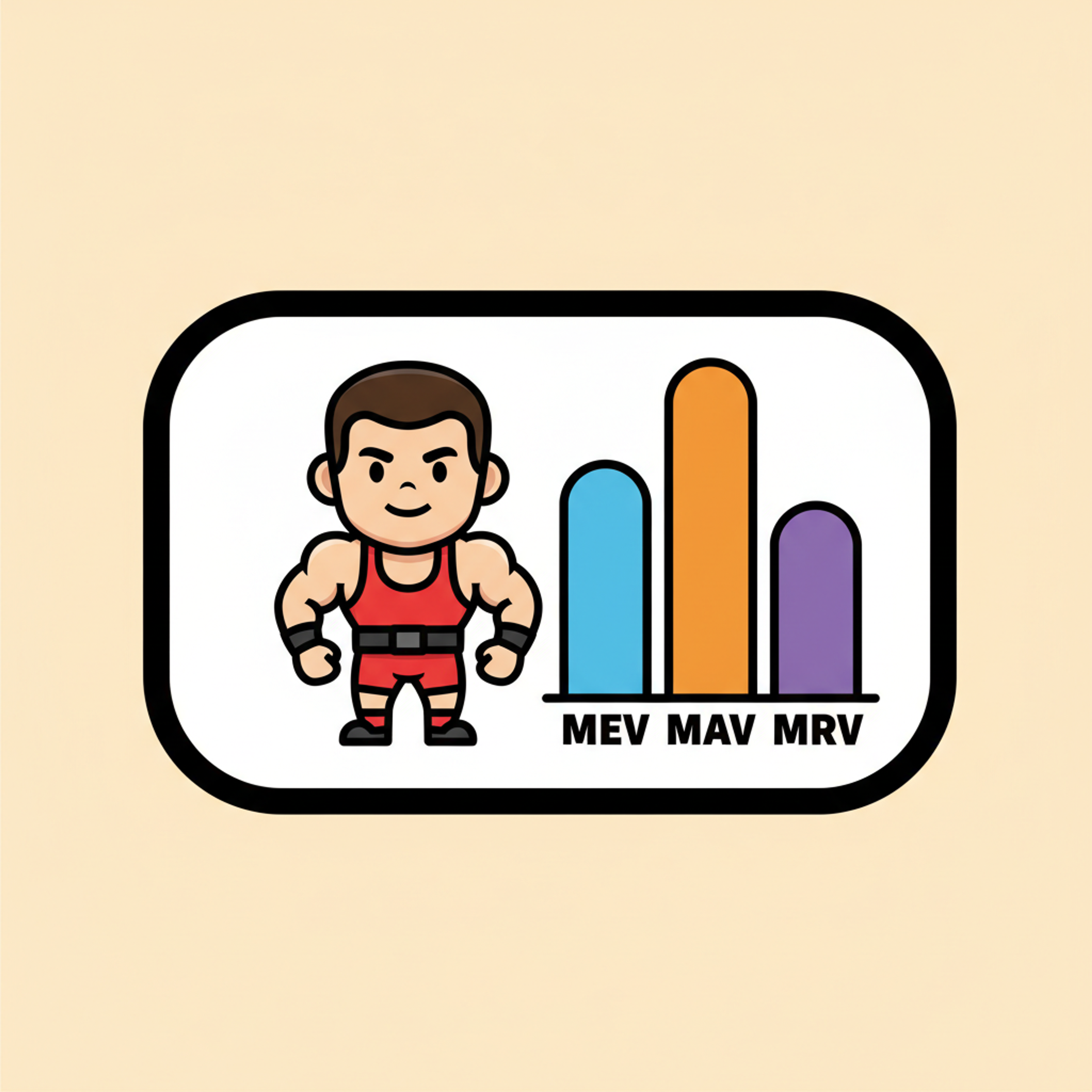
"How many sets should I do?"
If the answer is a static number like "3 sets of 10," you are leaving gains on the table. Volume—the total amount of work performed—is the primary driver of hypertrophy, assuming intensity is sufficient. But volume is not a scalar; it is a dynamic range that shifts based on your recovery capacity.
Dr. Mike Israetel formalized this into landmarks. Understanding them prevents you from wasting time doing too little (junk volume) or hurting yourself doing too much (overtraining).
The Volume Landmarks
MV: Maintenance Volume
This is the floor. It is surprisingly low. You can maintain muscle mass with as little as 6 hard sets per body part per week.
- Physiological Basis: Muscle tissue is metabolically expensive. The body wants to shed it. However, the signal required to keep tissue is much lower than the signal required to build it.
- Use Case:
- In-Season: Powerlifters reduce accessory volume to MV to focus recovery on S/B/D.
- Life Stress: When work/family stress peaks, drop to MV. You won't lose gains, and you won't burnout.
- Resensitization: Dropping to MV for a block can resensitize muscle to volume, making future growth phases more effective.
MEV: Minimum Effective Volume
This is the threshold where measurable growth begins. Anything below this is maintenance; anything above it is growth.
- The Trap: Many lifters stay here forever. They do just enough to get a pump (3 sets of 10, comfortable weight), but never enough to force adaptation.
- Identification: If you are getting a pump, but you are barely sore and recover fully within 24 hours, you are likely hovering around MEV.
MAV: Maximum Adaptive Volume
This is the "sweet spot." It is the range where you make the fastest progress. Crucially, MAV is a moving target. As you become adapted to a volume, your MAV shifts upward.
- The Progression: You might start a mesocycle doing 12 sets (MEV). By week 4, you might need 16 sets to get the same disruption. By week 6, maybe 20.
- Sign: You have great pumps, measurable soreness that dissipates just in time for the next session, and performance is increasing week over week.
MRV: Maximum Recoverable Volume
The ceiling. Beyond this point, you cannot recover. Systemic fatigue accumulates faster than local adaptation. Performance drops, sleep suffers, and joints ache.
- The Reality: Most "hardcore" lifters live here, constantly overreached, wondering why they aren't growing. They mistake "feeling trashed" for "growing."
Note: I personally spent 3 years without gains living in this area. I would improve the first month of training, Flat line the second and get worse the third
- Symptoms:
- Performance regression (you get weaker).
- Persistent joint pain.
- Insomnia or restless sleep.
- Loss of appetite and libido.
The Accumulation Strategy: Programming the Wave
The following is a example program in the the style Mike Israteal would program. Ive personally tried it for more bodybuilding stlye programming. Start with Something that gets you slightly sore but is easy and increase each week with enough to keep disruption from training each week.
Example Mesocycle (Chest):
- Week 1 (MEV+): 10 sets. (e.g., 3 sets Bench, 3 sets Incline, 4 sets Flyes). RPE 7. Establish baseline.
- Week 2 (Accumulation): 12 sets. Add 1 set to Incline and Flyes. RPE 7-8.
- Week 3 (Accumulation): 14 sets. Add weight or sets. RPE 8. You should feel significant fatigue.
- Week 4 (Peak MAV): 16-18 sets. High effort. RPE 9. You are pushing the envelope.
- Week 5 (Functional Overreaching): 20 sets (Approaching MRV). Go hard. You will feel battered by the end of this week. Performance might even stall slightly.
- Week 6 (Deload): 6 sets (MV). Drop fatigue. This allows the supercompensation from the previous weeks to manifest.
Pesonally I dont like this style for powerlifting however and prefer an emergent strategies style of programming where I dont change anything during the block and only increase or decrease volume block to block. I would however recommend in for purely hyperthropy oriented training.
A Note on Intensity
None of this matters if you are training like a coward. "Effective" sets must be taken close to failure (RPE 7-9).
- Junk Volume: Doing 20 sets of 10 with a weight you could lift 20 times is not "high volume." It is cardio.
- The Rule: If you finish a set and could have done 5 more reps with good form, that set did not count toward your volume landmarks. It was warm-up.
Practical Application: What This Looks Like in the Gym
Stop guessing. Start tracking.
- Log your sets: Not just "Bench." Log "Bench: 3 sets @ RPE 8."
- Assess weekly:
- Did I get a pump? (No -> Increase Volume).
- Was I sore? (No -> Increase Volume).
- Did I recover before the next session? (No -> DECREASE Volume).
- Did performance increase? (Yes -> Keep doing what you're doing).
- Don't be afraid to drop volume. If your bench press is stalling and your shoulders hurt, the answer is almost never "do more benching." It is "drop to MEV, let the inflammation subside, and rebuild."
Count hard sets. Ignore the rest.
About Rasmus
Powerlifter and coach with more than 7 years in the game.