Novices thrive on simplicity. Go to the gym, do 3 sets of 5, add weight, repeat. Linear progression is elegant and it works—until it doesn't.
Once the newbie gains stop, the body becomes resistant to adaptation. You can no longer improve everything at once. Trying to build maximal muscle and maximal neural efficiency simultaneously produces mediocrity at both.
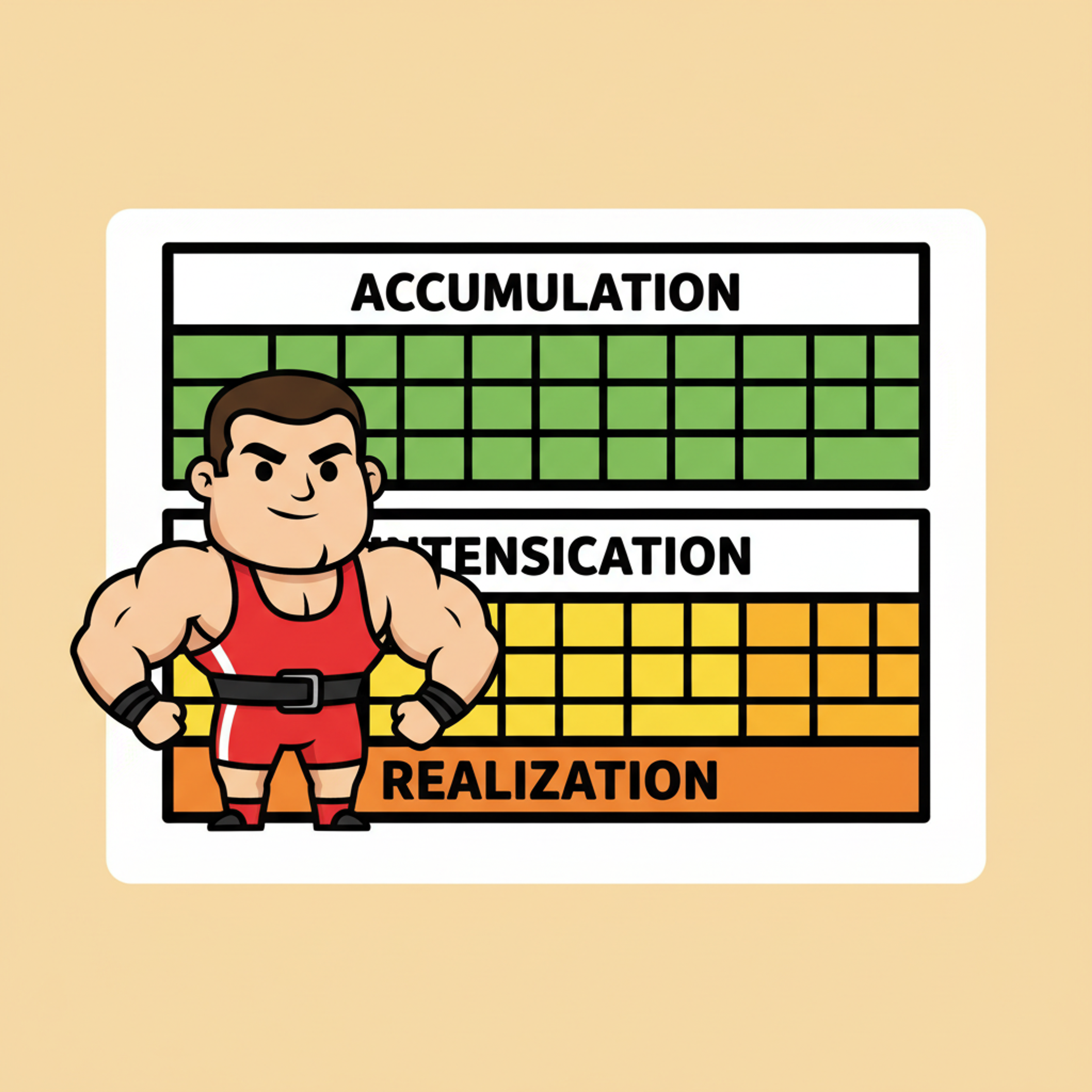
Advanced training requires block periodization: the strategic sequencing of phases where one trait is emphasized while others are maintained. This is phase potentiation in practice—Phase A builds the biological foundation that allows Phase B to work, which culminates in Phase C.
The Macrocycle Structure
A standard macrocycle (annual plan) is divided into mesocycles (blocks). The progression moves from general to specific and from high volume to high intensity.
Phase | Duration | Primary goal | Volume | Intensity | RPE
1. Hypertrophy (Accumulation) | 4–8 weeks | Increase muscle cross-sectional area | High | Moderate (65–75%) | 7–9
2. General Strength (Transmutation) | 4–6 weeks | Neural efficiency—teach the new muscle to fire | Moderate | High (75–90%) | 8–9
3. Realization (Peaking) | 2–3 weeks | Maximal expression—dissipate fatigue, reveal fitness | Low | Very high (90%+) | 9–10
4. Deload | 1 week | Supercompensation—complete fatigue removal | Very low | Low (50–60%) | 5–6
Why This Order Is Non-Negotiable
The sequence is dictated by residual training effects—how long a physical quality persists after you stop training it directly.
- Hypertrophy and aerobic adaptations last long (30+ days).
- Neural and peak strength adaptations are fleeting (5–7 days).
Build muscle first, because it stays. Refine strength next, while the new tissue is there. Sharpen the peak right before the deadline. You cannot peak first and then build; the peak will be long gone before the muscle arrives.
What Each Phase Looks Like
Phase 1: Hypertrophy (making the engine bigger)
- Squat: 4 × 8 at 70%.
- Accessories: Leg press, lunges, extensions—high volume.
- Feel: Pumped, sore, metabolically drained. The weight on the bar matters less than the tension on the muscle.
Phase 2: Strength (teaching the engine to run)
- Squat: 5 × 3 at 85%.
- Accessories: Volume drops. Specificity rises—pause squats instead of leg press.
- Feel: Joints feel heavy. The CNS is engaged. You are practicing the skill of moving very heavy weight.
Phase 3: Realization (rev it to the redline)
- Squat: One top single at 92–95%, back-off 2 × 2 at 80%.
- Accessories: Almost nothing. Light abs or hamstrings at most.
- Feel: Wired. The volume is so low you almost feel guilty leaving the gym, but the intensity of a top single demands real arousal.
The Lag Time
The work you do in January is what lets you hit a PR in April.
Lifters get discouraged during the hypertrophy block because their 1RM often temporarily drops. They are tired and haven't touched heavy weights in weeks. This is expected. You are investing in the future, not testing it yet.
If you try to hold peak intensity year-round, you will burn out or tear something. You cannot live at 100%. Respect the phases.
About Rasmus
Powerlifter and coach with more than 7 years in the game.