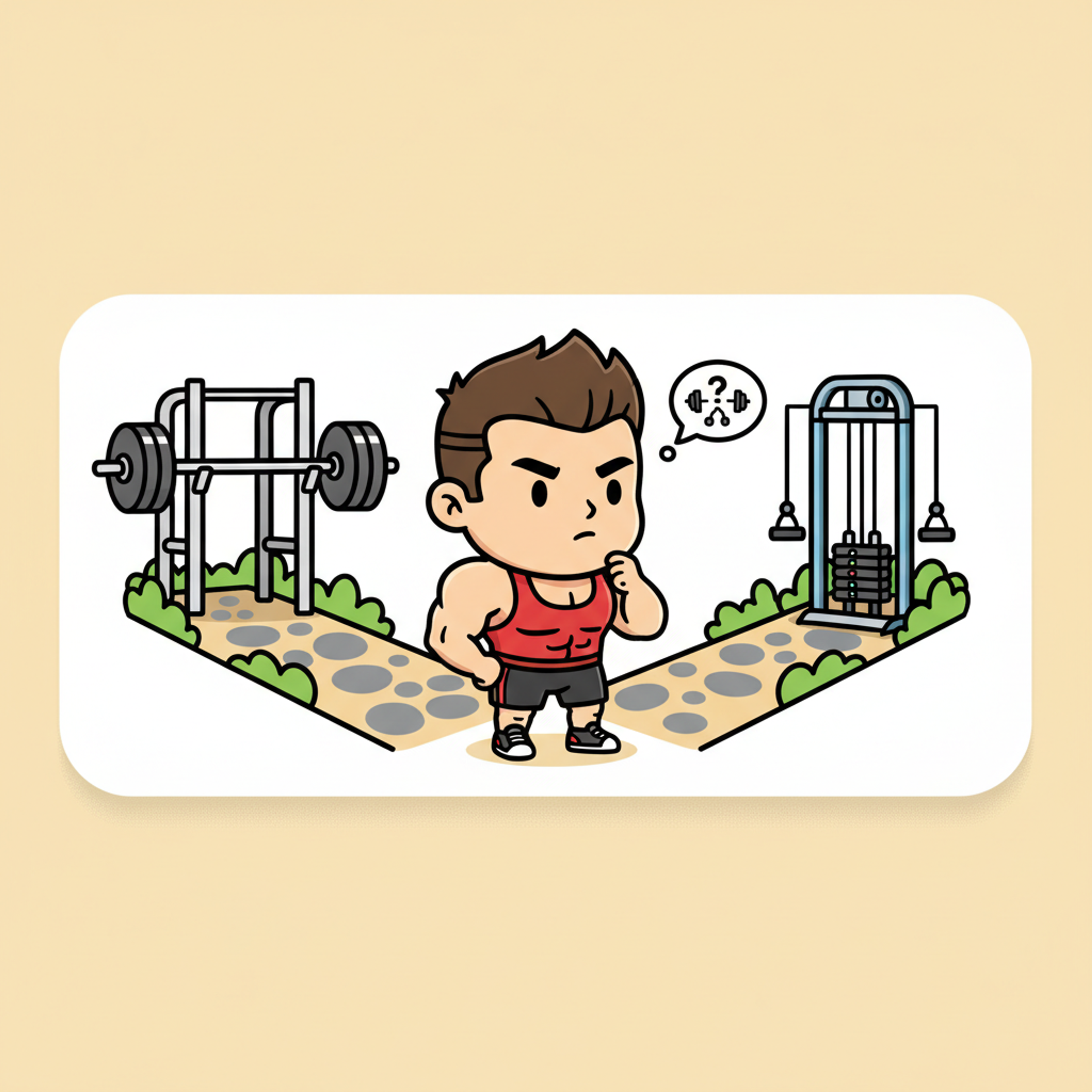
The standard answer: compounds first, isolation last. This is usually correct. But "usually" is doing a lot of work in that sentence.
The Case for Compounds First
Neural freshness matters for heavy lifting. Squats, deadlifts, and bench press require precise motor patterns, heavy loads, and full systemic engagement. Performing these after you have pre-fatigued the primary movers with isolation work is a direct performance compromise.
If you do a set of leg extensions to failure before squatting, your quads are partially pre-fatigued. Your squat will be weaker. You will get less out of the primary movement.
For strength-focused training, this is clearly wrong. The competition movements and their close variations must be performed with maximum quality. They go first.
You have more recovery capacity at the start of the session. The neurological and muscular demands of heavy compound work deplete finite recovery resources. The longer you push that depleting resource into the session, the less quality work you get from the most important exercises.
The Case for Isolation First (Pre-Exhaustion)
The pre-exhaustion principle argues that if you fatigue the primary mover before a compound exercise, it will be the limiting factor in the compound — not the secondary muscles.
Example: Bench press fails because the triceps give out, not the chest. Pre-fatiguing the chest with cable flys before bench pressing means the chest is now the limiting factor.
This is theoretically sound but practically limited. Research on pre-exhaustion shows mixed results for hypertrophy and consistently negative results for strength. Pre-fatiguing a muscle often reduces total volume capacity for the session without proportionally increasing the targeted muscle's stimulus.
Where it does work: In bodybuilding contexts, when a specific muscle is the explicit target and compound performance is not a priority. A chest-focused session where you are not concerned about total bench press weight might start with machine fly or cable crossover to establish a better chest mind-muscle connection before the barbell work.
The Practical Framework
Priority 1 — Strength sessions: Compounds always first. No exceptions. The quality of your main lifts is non-negotiable.
Priority 2 — Hypertrophy sessions: Compounds first, with moderate flexibility. You can start with a pre-exhaust if you have a specific weakness and can accept the performance cost.
Priority 3 — Isolation-focused sessions: Order by personal preference and pump quality. If it is a dedicated arm day, the order of curls vs. tricep work matters far less than total volume and effort.
The Question That Actually Matters
Before asking whether to do compounds or isolations first, ask: what is the purpose of this session?
If the session is built around a compound movement — squat day, deadlift day, bench day — the answer is obvious. The compound comes first.
If the session is accessory and hypertrophy work with no primary strength focus, the order becomes a matter of targeting priorities, not a rule.
The standard advice exists because most programs are built around compound movements. Follow it by default, and only deviate with a specific reason.
About Rasmus
Powerlifter and coach with more than 7 years in the game.
Related Articles
Should You Do Speed Work
Speed work sounds like it's for athletes. You are a powerlifter. You lift heavy things slowly.

Should You Use a Belt in Training
The belt debate produces more heat than light. One camp says never use a belt — you need to build raw core strength first. The other says always wear a belt — protect your spine at all costs.
Does Arm Training Actually Matter for Your Bench
The conventional wisdom in powerlifting: don't bother with curls, your arms get enough work from the big lifts. The conventional wisdom in bodybuilding: arms need direct work to grow. Both camps are p