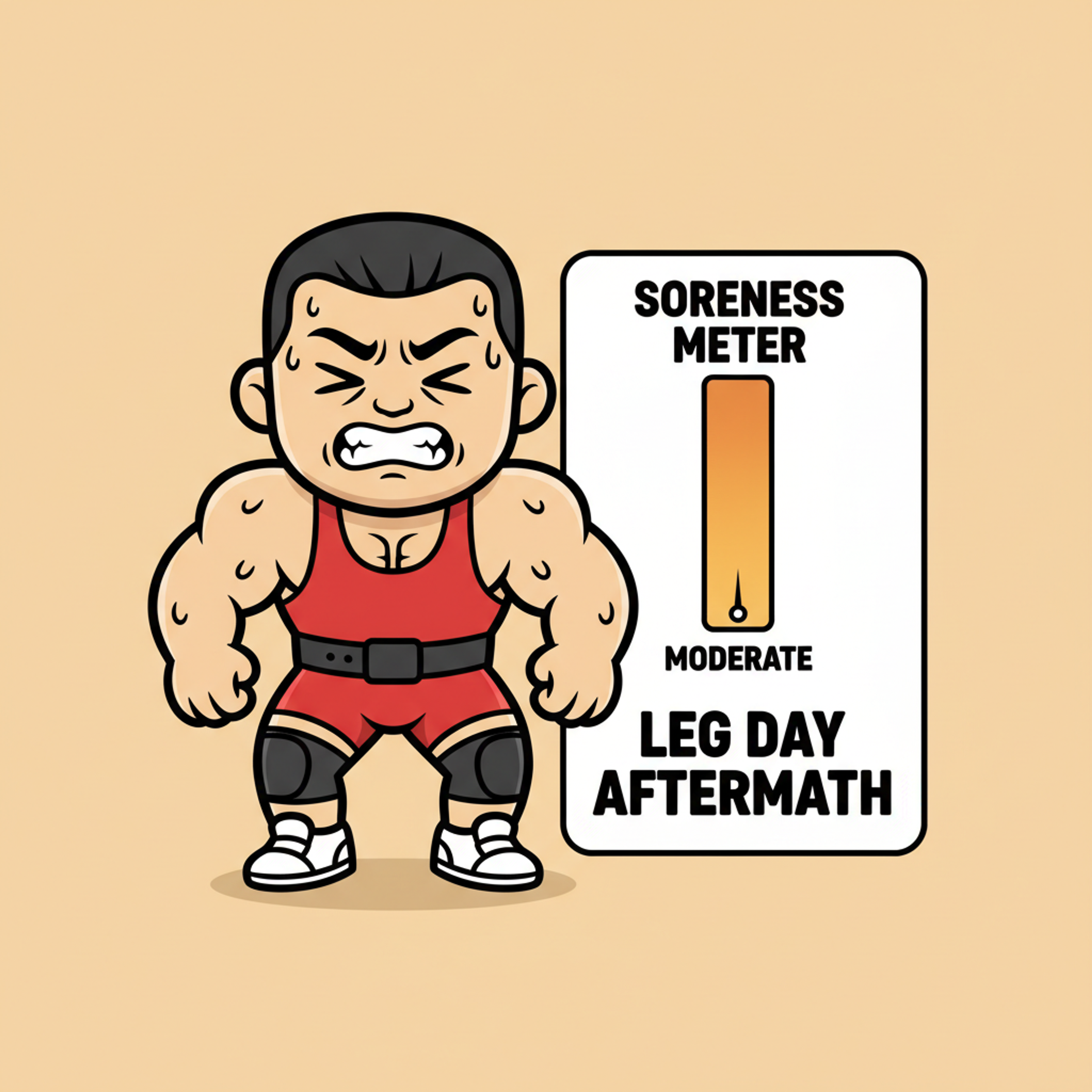
Soreness after training is normal. Soreness that prevents you from moving normally for five days is not. Understanding the difference determines whether you are training productively or damaging yourself.
What Causes DOMS
Delayed Onset Muscle Soreness (DOMS) peaks 24–72 hours after training. It is caused primarily by eccentric loading — the lengthening phase of a movement under tension.
Descending stairs (quads contracting eccentrically), lowering a barbell to your chest, the bottom of a Romanian deadlift — these are the mechanical events that create micro-trauma in muscle fibers. The subsequent soreness is the inflammatory response to that trauma.
DOMS is not a reliable indicator of training quality. You can have an excellent hypertrophic training session with minimal soreness. You can be brutally sore from doing something novel and unfamiliar that provides little actual training stimulus. Soreness measures novelty, not effectiveness.
Normal Soreness
Mild to moderate soreness: Tenderness when the muscle is pressed, stiffness through the range of motion, discomfort when the muscle is fully lengthened. This resolves within 24–72 hours.
Moderate soreness after returning from a break or trying new exercises: Up to 4–5 days of soreness can be normal after significant training disruption. Your muscle fibers are remodeling in response to an unfamiliar stimulus.
Training through mild to moderate soreness: Generally fine. The muscle is not damaged in a meaningful way. Active movement (walking, light training) actually speeds DOMS resolution by increasing blood flow and clearance of metabolic byproducts.
Soreness That Warrants Attention
Soreness that worsens after day 2–3: Normal DOMS peaks and then fades. If the pain is intensifying by day 3 or day 4, something other than standard DOMS may be occurring.
Swelling and significant strength loss: Some muscle soreness with temporary strength reduction is normal. If a limb is visibly swollen and you have lost the majority of strength in that muscle group, this may indicate more significant muscle damage.
Dark urine after extremely intense training: This is a symptom of rhabdomyolysis — the breakdown of muscle tissue to the point that myoglobin is released into the bloodstream and filtered through the kidneys. This is a medical emergency and requires immediate evaluation. Rhabdo is rare in standard training but can occur after extreme volumes of unfamiliar work (a brutal CrossFit class for a sedentary person, for example).
Joint pain vs. muscle pain: DOMS is located in the muscle belly, not the joint. Sharp, localized pain at a joint during or after training is not DOMS — it is a red flag that warrants rest and assessment.
Practical Guidelines
Do not program your most intense sessions back-to-back. A heavy squat session followed by a leg-focused hypertrophy session 24 hours later is how you end up unable to sit down.
Introduce new exercises and volumes gradually. The worst DOMS comes from novel stimuli. When starting a new program, run the first week at 60–70% of the intended volume.
Soreness is not the goal. Training programs designed to maximize soreness are optimizing for the wrong thing. The goal is progressive adaptation. If you are consistently crippled for 4 days after every session, you are training past what you can recover from.
Train hard. Recover. Soreness is a side effect, not a scoreboard.
About Rasmus
Powerlifter and coach with more than 7 years in the game.
Related Articles
Should You Do Speed Work
Speed work sounds like it's for athletes. You are a powerlifter. You lift heavy things slowly.
Should You Use a Belt in Training
The belt debate produces more heat than light. One camp says never use a belt — you need to build raw core strength first. The other says always wear a belt — protect your spine at all costs.
Does Arm Training Actually Matter for Your Bench
The conventional wisdom in powerlifting: don't bother with curls, your arms get enough work from the big lifts. The conventional wisdom in bodybuilding: arms need direct work to grow. Both camps are p