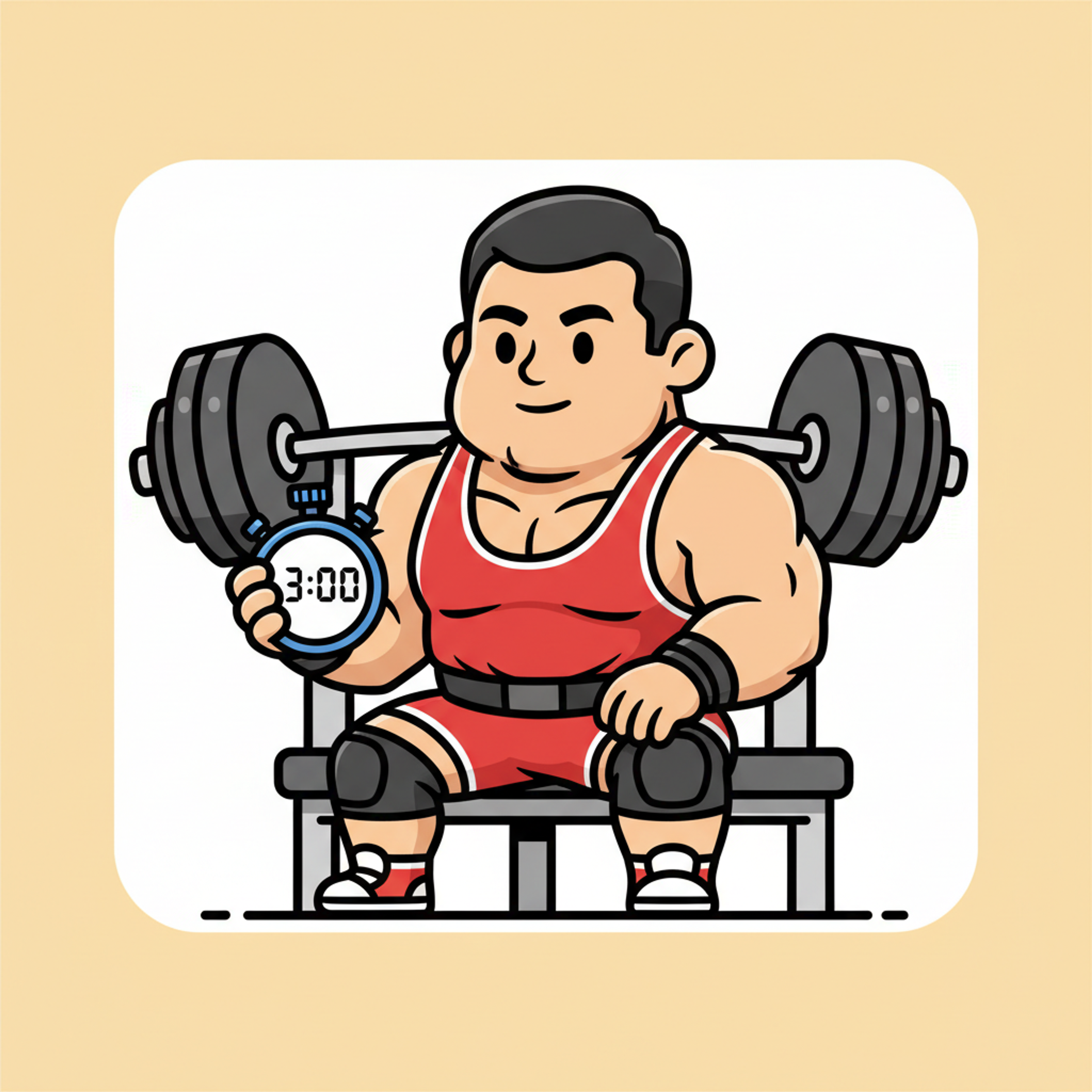
Rest period recommendations range from 30 seconds to 5 minutes depending on who you ask. The correct answer depends on what you are trying to achieve — and most people rest either too little or too long for their stated goal.
What Happens During Rest
Between sets, your body is doing several things simultaneously:
- Replenishing phosphocreatine (PCr): The primary fuel source for high-intensity efforts. PCr is depleted in 10–30 seconds of max effort and replenishes at roughly 95% in 3–5 minutes.
- Clearing metabolic byproducts: Lactate and hydrogen ions accumulate during high-rep efforts. These contribute to the burning sensation and performance degradation in subsequent sets.
- Restoring neural readiness: The central nervous system fatigues independently of muscular fatigue. Heavy neural work requires longer recovery.
The rest period needed depends on which of these is the limiting factor for your training goal.
Rest for Strength
Target: 3–5 minutes between heavy sets.
Strength training at 85%+ of max is limited primarily by phosphocreatine replenishment and neural readiness. Both require substantial rest for full recovery.
Shortening rest below 2 minutes on heavy triples or doubles means the subsequent set is performed in a partially recovered state — you will use lower loads, get fewer reps, or compromise technique. Over time, this reduces the quality of strength training significantly.
Elite powerlifters often rest 5–8 minutes between competition-weight attempts in training. This is not laziness — it is ensuring maximum quality on each effort.
Rest for Hypertrophy
Target: 1.5–3 minutes between hypertrophy sets.
The research here has evolved. Earlier guidance suggested 60–90 seconds was optimal for hypertrophy due to elevated lactate and hormonal responses. More recent work by researchers including Brad Schoenfeld shows that longer rest periods (2–3 minutes) produce equal or greater hypertrophy because they preserve performance across sets.
If you rest 60 seconds and do 3 sets of 12, you might get 12 / 10 / 7 reps due to accumulating fatigue. If you rest 2.5 minutes and do 3 sets of 12, you might get 12 / 11 / 10 — significantly more total volume.
Total volume (sets × reps × weight) is the primary driver of hypertrophy. Rest periods that maintain volume across sets are superior to those that artificially constrain it.
Rest for Metabolic Conditioning
Target: 30–90 seconds.
If the goal is cardiovascular adaptation, work capacity, or caloric expenditure, short rest periods are appropriate. The performance cost is the point — you are training the energy systems to work under fatigue.
This is not relevant for strength or hypertrophy-focused training and should not bleed into those sessions.
Practical Table
Goal | Intensity | Rest period
Maximal strength | 85–100% | 3–5 min
Strength/hypertrophy hybrid | 75–85% | 2–3 min
Hypertrophy | 60–80% | 90 sec – 3 min
Metabolic / conditioning | 40–60% | 30–90 sec
The Common Mistake
Most gym-goers rest too little for strength work and this is why their strength stalls. They feel guilty taking 4-minute rests, so they cut to 90 seconds and wonder why they cannot add weight.
The other mistake: resting too long on hypertrophy work because they are on their phone and lose track of time. 7 minutes between a set of cable laterals is not rest — it is the next set failing to exist.
Set a timer. Use rest periods as a training variable, not an afterthought.
About Rasmus
Powerlifter and coach with more than 7 years in the game.
Related Articles

Should You Do Speed Work
Speed work sounds like it's for athletes. You are a powerlifter. You lift heavy things slowly.

Should You Use a Belt in Training
The belt debate produces more heat than light. One camp says never use a belt — you need to build raw core strength first. The other says always wear a belt — protect your spine at all costs.
Does Arm Training Actually Matter for Your Bench
The conventional wisdom in powerlifting: don't bother with curls, your arms get enough work from the big lifts. The conventional wisdom in bodybuilding: arms need direct work to grow. Both camps are p