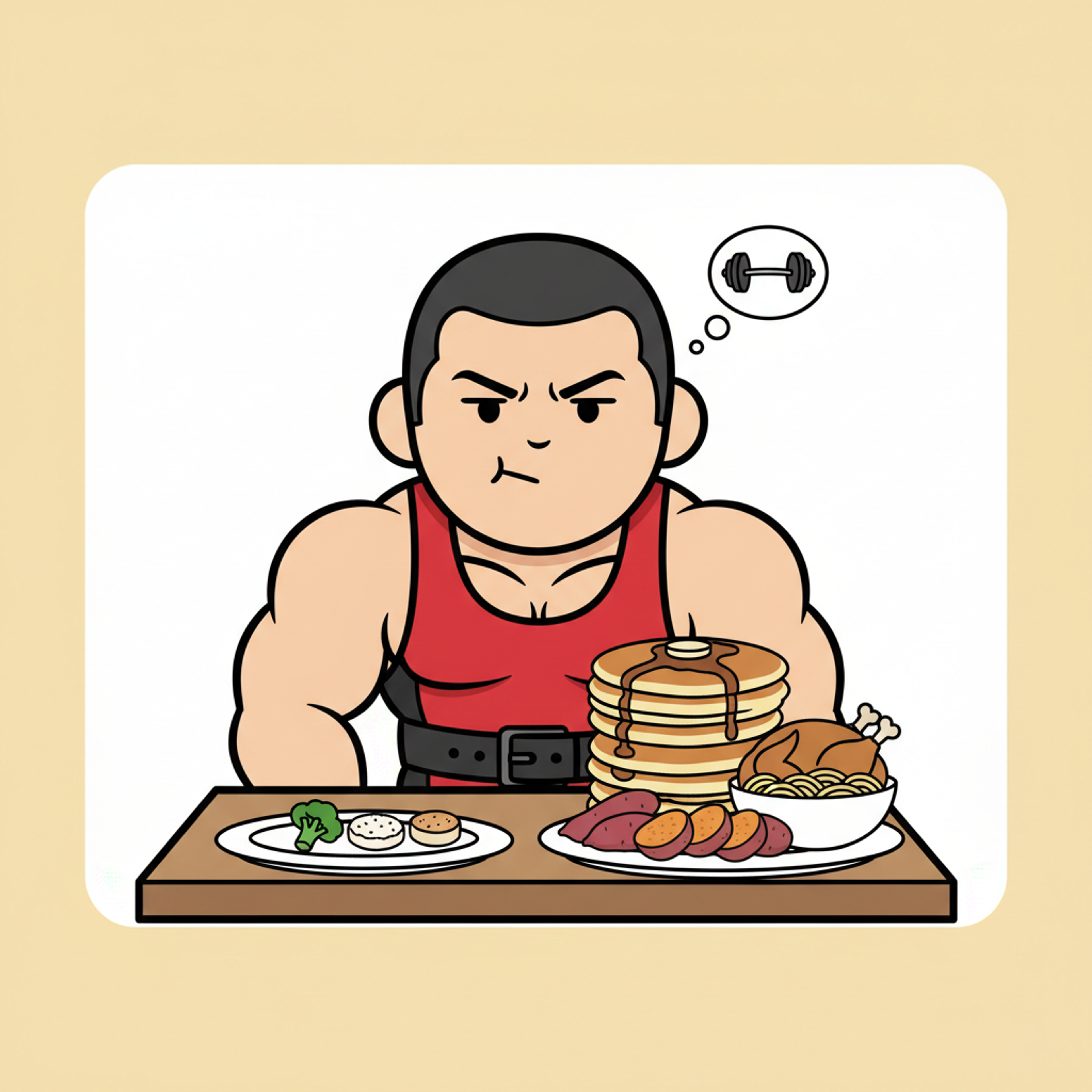
You want to build muscle. Someone told you to eat in a calorie surplus. Now you need to know how big that surplus should be.
The short answer: smaller than you think, for longer than you want.
The Biology
Muscle synthesis has a ceiling. Your body can only build muscle tissue so fast — roughly 0.5–2 lbs of actual muscle per month depending on training age, genetics, and how hard you are working. This ceiling does not move because you ate more calories.
Calories above what your body can use for muscle protein synthesis go somewhere else. Primarily: body fat.
This is the central problem with the "dirty bulk." You can eat 1000 calories over maintenance and gain weight quickly. But the muscle component of that weight gain is the same as if you had eaten 300 calories over maintenance. The extra 700 calories are just stored as fat you will have to diet off later.
What the Research Shows
Studies comparing modest surpluses (200–500 kcal/day) to large surpluses (800–1000+ kcal/day) consistently find:
- Similar rates of muscle gain
- Significantly more fat gain in the large surplus group
The larger surplus does not accelerate muscle growth meaningfully. It accelerates fat accumulation.
The Practical Target
For most intermediate lifters: 200–350 kcal/day above maintenance.
At this level:
- You are consistently in a building state
- The fat gain rate is slow enough to tolerate a longer bulk before needing a cut
- Bodyweight increases roughly 0.25–0.5% per week
Expected weight gain by training age:
Training age | Muscle potential per month | Recommended surplus
Beginner (< 1 year) | 1.5–2 lbs | 300–500 kcal
Intermediate (1–3 years) | 0.75–1.5 lbs | 200–350 kcal
Advanced (3+ years) | 0.25–0.75 lbs | 100–250 kcal
Advanced lifters often do best near maintenance — the surplus required to support their slow muscle growth rate is small enough that the distinction between maintenance and bulking blurs.
When a Larger Surplus Makes Sense
True beginners. In the first 3–6 months of training, the muscle growth rate is high enough that a larger surplus (400–600 kcal) is appropriate and will largely be used.
Hard gainers who undereat chronically. If you struggle to hit maintenance calories consistently, a larger target provides buffer.
Aggressive programming blocks. If you are running high volume and high frequency deliberately, recovery demands increase and a larger surplus supports that.
The Dirty Bulk Isn't Faster. It's Just Messier.
The appeal of the dirty bulk is psychological. Eating whatever you want feels like commitment. More food feels like more gains. Faster weight gain feels like progress.
The math does not support it. After a 6-month dirty bulk, you will spend 3 months dieting to get back to a reasonable body fat percentage — at which point you have not gained net time on building, you have lost it.
Eat enough to support muscle growth. Not so much that you are financing a fat gain you will have to reverse.
About Rasmus
Powerlifter and coach with more than 7 years in the game.
Related Articles
Should You Eat Before You Work Out
The fear: train fasted and your body will eat your muscle for fuel. The counter-fear: eat too close to training and you will be nauseous under a heavy squat.
Can You Build Muscle While Losing Fat
Body recomposition — gaining muscle and losing fat simultaneously — is real. It is also frequently overhyped and often applied to people it will not work for.

What to Eat on Rest Days
Rest days produce a lot of unnecessary anxiety. Do you eat less? Do you cut carbs? Do you maintain exactly what you eat on training days?